
What is known about the language development of multilingual children in very linguistically diverse societies, and what are the implications for multilingual education? This is the topic of a lecture by Prof. Ajit Mohanty at Jawaharlal Nehru University, India, summarized in this post. (You can watch the lecture yourself here.) I like this lecture becauseContinue reading “Growing up with languages: Implications for multilingual education”
Category Archives: Literature summaries
Is translanguaging possible on (standardized) tests?

In a 2011 article in Modern Language Journal, Elana Shohamy, a language assessment specialist at the University of Tel Aviv, addresses the question of whether language tests can be multilingual. To answer this question, Shohamy explains that tests need to meet two criteria to be valid: first, they have to measure a construct, such asContinue reading “Is translanguaging possible on (standardized) tests?”
The “multi/plural turn”: A major trend in theorizing Second Language Acquisition

What is the “multi/plural” turn that changed our understanding of second language acquisition (SLA) around the start of the 21st century? This post explains (1) emergentism, a relatively new theory about how the language repertoire evolves across the lifespan, and (2) how emergentism suggests that we need to approach additional language acquisition from a multilingualContinue reading “The “multi/plural turn”: A major trend in theorizing Second Language Acquisition”
Bringing together translanguaging and Task Based Language Teaching (TBLT)

This study investigated the use of translanguaging and Task Based Language Teaching (TBLT) together in a secondary EFL class. The authors begin by summarizing research on translanguaging and TBLT, and discussing where the two theories of language teaching meet, comparing and contrasting their similarities/differences and concluding, overall, that they have many commonalities. Next, the authorsContinue reading “Bringing together translanguaging and Task Based Language Teaching (TBLT)”
Using translanguaging to teach vocabulary across the regional language, the national language, and English

In this week’s post, I summarize a single reading on pedagogical translanguaging for teaching vocabulary and morphological awareness across 3 languages. Why 3 languages? It is quite common for countries to have a three-level linguistic hierarchy: the regional/indigenous languages, the national language, and English. Therefore, this study by Leonet, Cenoz, and Gorter (2020) on howContinue reading “Using translanguaging to teach vocabulary across the regional language, the national language, and English”
How can non-academics engage in more equal dialogue with scholars to make translanguaging “transformative”?

In 2018, Jürgen Jaspers, a professor of sociolinguistics at Université Libre de Bruxelles, published a critical essay titled “The Transformative Limits of Translanguaging.” In this blog post, I first summarize that essay, which questions the extent to which translanguaging is a transformative educational practice in and of itself. Second, I summarize an earlier article byContinue reading “How can non-academics engage in more equal dialogue with scholars to make translanguaging “transformative”?”
Definitions and examples of translanguaging: Do they remain justice-oriented? – Two lit reviews from the Global “North” and “South”

In 2017, Luis Poza, an assistant professor of Education in the U.S., examined 53 studies on translanguaging (1996-2014), investigating how the term was defined in each study, what examples were given, and what percentage of studies linked translanguaging to educational reform for linguistically and culturally marginalized students, as opposed to merely promising that translanguaging wouldContinue reading “Definitions and examples of translanguaging: Do they remain justice-oriented? – Two lit reviews from the Global “North” and “South””
Researching translanguaging in education: Beyond the social justice oriented classroom intervention

Most studies connecting translanguaging, education, and social justice take the form of participatory action research—i.e., teacher-scholar partnerships to promote translanguaging in classrooms. In this post, I describe two other research methods relevant to these topics: (1) interviews and document analysis of language attitudes and policies, and (2) ethnography in which the researcher is a “flyContinue reading “Researching translanguaging in education: Beyond the social justice oriented classroom intervention”
Views on Translanguaging: Scholars vs Teachers vs Students

If a school officially provides instruction in the dominant societal language, but has multilingual students from many language backgrounds, what should be done with students’ languages according to the teachers and students themselves? To answer this question, four translanguaging researchers visited classes in two public and two private international schools in the Netherlands to recordContinue reading “Views on Translanguaging: Scholars vs Teachers vs Students”
How should teachers use students’ first language and why does it matter? – Lessons from gr. 8 EFL science classes where students had elementary English proficiency
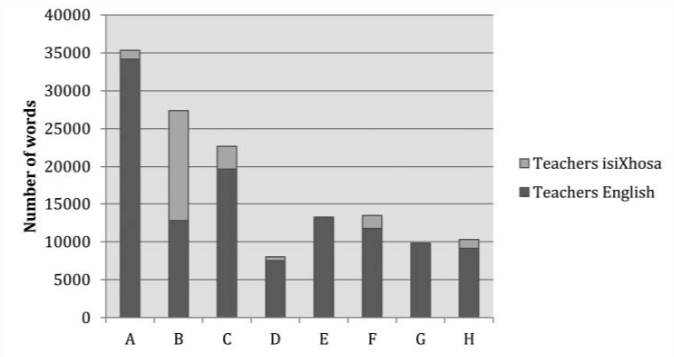
English is the home language of only 1 in 10 people in South Africa, but it is widely used as a medium of instruction from grade 4 onward, regardless of how little students understand. What, then, is the role of students’ L1(s) in this situation? Prof. Margie Probyn video-recorded a series of 5 lessons fromContinue reading “How should teachers use students’ first language and why does it matter? – Lessons from gr. 8 EFL science classes where students had elementary English proficiency”
 annamend