
No scholar of bi/multilingualism has had as large an impact as Ofelia García, with her far-reaching positive effect on education in the U.S. and internationally. In this post, I argue that we should focus on this far-reaching pedagogical effect—of how she conceptualizes language learners’ bi/multilingualism—which leads to a more socially just way of teaching languages,Continue reading “The historical development of translanguaging – On the legacy of Ofelia García”
Author Archives: annamend
What is code-meshing? (with comparisons to code-switching and translanguaging)

In this definition post, I discuss the term “code-meshing,” which comes from Vershawn Young, an African-American scholar, and Suresh Canagarajah, a Sri Lankan scholar who teaches in the United States. In the term “code-meshing,” Young and Canagarajah provide possibly the best solution to the social and educational problems that arise when learning “standard” English isContinue reading “What is code-meshing? (with comparisons to code-switching and translanguaging)”
Researching translanguaging in education: Beyond the social justice oriented classroom intervention

Most studies connecting translanguaging, education, and social justice take the form of participatory action research—i.e., teacher-scholar partnerships to promote translanguaging in classrooms. In this post, I describe two other research methods relevant to these topics: (1) interviews and document analysis of language attitudes and policies, and (2) ethnography in which the researcher is a “flyContinue reading “Researching translanguaging in education: Beyond the social justice oriented classroom intervention”
Views on Translanguaging: Scholars vs Teachers vs Students

If a school officially provides instruction in the dominant societal language, but has multilingual students from many language backgrounds, what should be done with students’ languages according to the teachers and students themselves? To answer this question, four translanguaging researchers visited classes in two public and two private international schools in the Netherlands to recordContinue reading “Views on Translanguaging: Scholars vs Teachers vs Students”
How should teachers use students’ first language and why does it matter? – Lessons from gr. 8 EFL science classes where students had elementary English proficiency
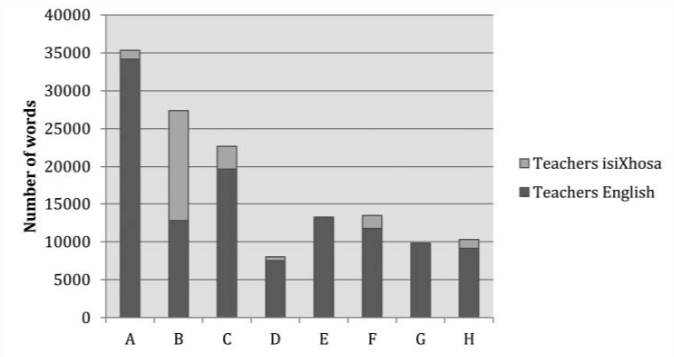
English is the home language of only 1 in 10 people in South Africa, but it is widely used as a medium of instruction from grade 4 onward, regardless of how little students understand. What, then, is the role of students’ L1(s) in this situation? Prof. Margie Probyn video-recorded a series of 5 lessons fromContinue reading “How should teachers use students’ first language and why does it matter? – Lessons from gr. 8 EFL science classes where students had elementary English proficiency”
When should I allow or encourage translanguaging in an academic subject class taught in English?

This is not going to be a prescriptive post since translanguaging is about dynamic activity flows, even in academic subject classes taught in English (Lin & He, 2017), known as Content Language Integrated Learning (CLIL) — or in the U.S., as “sheltered instruction” for ESL students. In these classes, students must get enough exposure toContinue reading “When should I allow or encourage translanguaging in an academic subject class taught in English?”
How does translanguaging pedagogy work when most, but not all, students share the same home language?

In another post, I wrote about a “superdiverse” class with 27 students, 8 home languages, and 1 (monolingual) teacher. There were obvious challenges to implementing translanguaging pedagogy in that classroom, even though the teacher successfully did. He was helped by a school and community environment supportive of bi/multilingualism, in a city that was historically diverse,Continue reading “How does translanguaging pedagogy work when most, but not all, students share the same home language?”
How does translanguaging pedagogy work with 27 students, 8 home languages, and 1 monolingual teacher?

“Eight home languages. Twenty-seven students. Twenty-seven levels of English language development, home language literacy, and content knowledge. One room. One teacher. This is the reality of Andrew Brown’s 5th-grade class.” So begins the article co-authored by Mr. Brown and his researcher friend Heather Woodley after doing professional development with Ofelia García in New York. ThisContinue reading “How does translanguaging pedagogy work with 27 students, 8 home languages, and 1 monolingual teacher?”
Good news, bad news, and something to look forward to in 2021!

In the last semester of my PhD, I was auditing an advanced graduate seminar in psycholinguistics in which the professor began the three-hour meetings with the same exercise her children’s elementary school teachers used to do: “a rose, a thorn, or a bud.” The basic premise was to give students a choice to share oneContinue reading “Good news, bad news, and something to look forward to in 2021!”
What does translanguaging look like in English-as-a-Foreign Language contexts?

In 2012, Graham Hall and Guy Cook did a survey for the British Council on bi/multilingual language use in K-12 and adult English classrooms. Within three months, they had 2,785 teachers from 111 countries participate. Hall and Cook did not call the practice “translanguaging” but referred to teachers’ use of students’ “own language” — notContinue reading “What does translanguaging look like in English-as-a-Foreign Language contexts?”
 annamend