
This post is an introductory chapter (for teacher education) on what translanguaging has to do with emotional well-being and ultimately with learning. I first review a cutting-edge academic paper on translanguaging and emotion (Dovchin, 2021), but since this blog is focused on K-12 education, I next review two classroom-based studies that show what translanguaging andContinue reading “Translanguaging and Emotion”
Category Archives: ethnography
When students (do not) accept their teachers’ translanguaging: A tale of two teachers

There is a lot of research on what teachers make of their students’ translanguaging. Less research is on what students make of their teachers’ translanguaging. This is one topic addressed in a year-long linguistic ethnography by Jaspreet Kaur Takhi and her mentors, translanguaging scholars Angela Creese and Adrian Blackledge. Their study took place in aContinue reading “When students (do not) accept their teachers’ translanguaging: A tale of two teachers”
How can non-academics engage in more equal dialogue with scholars to make translanguaging “transformative”?

In 2018, Jürgen Jaspers, a professor of sociolinguistics at Université Libre de Bruxelles, published a critical essay titled “The Transformative Limits of Translanguaging.” In this blog post, I first summarize that essay, which questions the extent to which translanguaging is a transformative educational practice in and of itself. Second, I summarize an earlier article byContinue reading “How can non-academics engage in more equal dialogue with scholars to make translanguaging “transformative”?”
Researching translanguaging in education: Beyond the social justice oriented classroom intervention

Most studies connecting translanguaging, education, and social justice take the form of participatory action research—i.e., teacher-scholar partnerships to promote translanguaging in classrooms. In this post, I describe two other research methods relevant to these topics: (1) interviews and document analysis of language attitudes and policies, and (2) ethnography in which the researcher is a “flyContinue reading “Researching translanguaging in education: Beyond the social justice oriented classroom intervention”
How should teachers use students’ first language and why does it matter? – Lessons from gr. 8 EFL science classes where students had elementary English proficiency
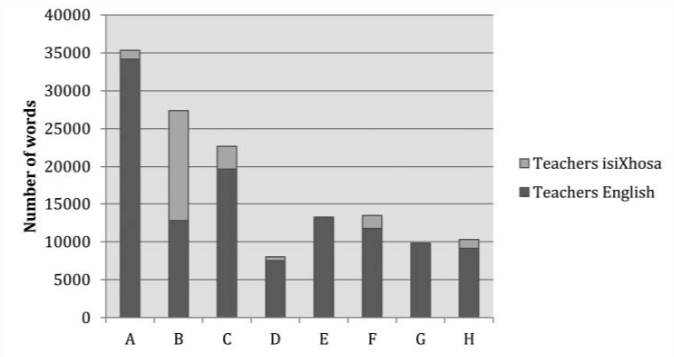
English is the home language of only 1 in 10 people in South Africa, but it is widely used as a medium of instruction from grade 4 onward, regardless of how little students understand. What, then, is the role of students’ L1(s) in this situation? Prof. Margie Probyn video-recorded a series of 5 lessons fromContinue reading “How should teachers use students’ first language and why does it matter? – Lessons from gr. 8 EFL science classes where students had elementary English proficiency”
How does translanguaging pedagogy work when most, but not all, students share the same home language?

In another post, I wrote about a “superdiverse” class with 27 students, 8 home languages, and 1 (monolingual) teacher. There were obvious challenges to implementing translanguaging pedagogy in that classroom, even though the teacher successfully did. He was helped by a school and community environment supportive of bi/multilingualism, in a city that was historically diverse,Continue reading “How does translanguaging pedagogy work when most, but not all, students share the same home language?”
How does translanguaging pedagogy work with 27 students, 8 home languages, and 1 monolingual teacher?

“Eight home languages. Twenty-seven students. Twenty-seven levels of English language development, home language literacy, and content knowledge. One room. One teacher. This is the reality of Andrew Brown’s 5th-grade class.” So begins the article co-authored by Mr. Brown and his researcher friend Heather Woodley after doing professional development with Ofelia García in New York. ThisContinue reading “How does translanguaging pedagogy work with 27 students, 8 home languages, and 1 monolingual teacher?”
How do we know translanguaging benefits language acquisition?

Though the socioemotional and critical pedagogy aspects of translanguaging have often been researched, what remains under-researched is the extent to which translanguaging benefits language development. This is not the kind of question that can simply be researched through pre-tests and post-tests. Using painstaking analysis of transcripts of student-centred interaction as her main data source, VinitiContinue reading “How do we know translanguaging benefits language acquisition?”
 annamend